How to Ride the Seoul Subway: Lines, Transfers, Fares, Apps, Etiquette
How to ride the Seoul subway: pay with T-money, read line colors and exits, transfer for free, check fares from 1,550 won, use apps and follow etiquette.

The easiest way to ride the Seoul subway is with a rechargeable transit card such as T-money. You tap it at the gate going in and again going out, and you follow the color and number of your line. With a card, an adult pays a base fare of 1,550 won for the first 10 km. Changing lines inside a station costs nothing extra. This guide takes you from the station entrance to the right exit and covers fares, transfer rules, the Climate Card pass, apps and etiquette. Prices and rules are as of November 4, 2026.
How to ride the Seoul subway, step by step
- Plan your route in an app. Enter your destination in Naver Map or KakaoMap. Both have English menus. The app tells you which line to take, which direction, how many stops, and which exit to use at the end.
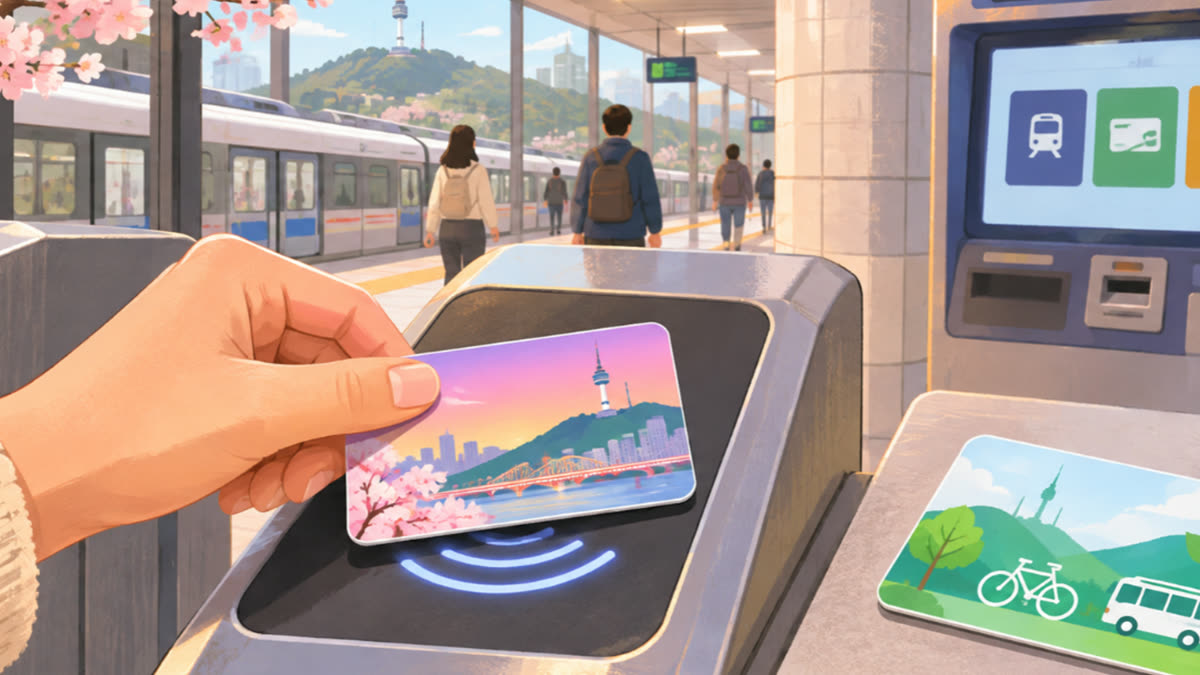
- Tap in with a card. Hold a T-money card, a Climate Card or a Korean transit-enabled bank card over the reader at the gate. If you don't have a card, buy a single-journey ticket (see the fares below).
- Pick the right platform. Platform signs show the line color and number, plus the station the train is heading toward. Check the direction name before you go down the stairs, because some stations have separate entrances for each direction.
- Ride and watch the screens. Announcements are in Korean and English, and on many trains in Chinese and Japanese too. Screens above the doors show the next station and, on most trains, which side the doors will open on.
- Change lines inside the station. Follow the colored signs for your next line. Transfers between subway lines happen inside the paid area, so you don't go through a gate.
- Tap out and use the right exit. Tap your card again at the exit gate. The system works out the distance-based fare at this point. Then follow the signs to the exit number your app gave you. Large stations have many numbered exits, and the wrong one can leave you several blocks from where you want to be.
How do Seoul subway lines work?
The network is officially called the Seoul Metropolitan Subway. It covers Lines 1 to 9 plus many lines that run out into Gyeonggi Province and Incheon, run by several different operators. Examples include the Shinbundang Line, the Suin-Bundang Line, the Gyeongui-Jungang Line, the AREX airport railroad and the GTX-A express line. They are all part of one fare and transfer system, so one transit card works across the whole network.

Every line has its own number and color. For example, Line 2 is green and Line 3 is orange. Stations have a number as well as a name, which helps if you can't read Korean. Line 2 runs in a loop, so its directions are called inner circle and outer circle rather than being named after end stations. Some lines, including Line 9, run both local and express trains. Express trains skip smaller stations, so check the train type on the platform screen before you board.
If you are coming in from the airport, our guide Incheon Airport to Seoul: AREX vs Airport Bus vs Taxi, Day and Night covers that part of the trip.
How much is the Seoul subway fare?
From the first train on June 28, 2025, the adult base fare went up from 1,400 won to 1,550 won. Teen and child fares went up on the same day. The new fares apply on Seoul, Incheon, Gyeonggi and Korail lines. For adults and teens, a card is cheaper than a single-journey ticket.
| Rider | Transit card | Single-journey ticket |
|---|---|---|
| Adult (19+) | 1,550 won | 1,650 won + 500 won deposit |
| Teen (middle and high school students) | 900 won | 1,650 won + 500 won deposit |
| Child (6–12) | 550 won | 550 won + 500 won deposit |
Base fares for trips up to 10 km, as of November 4, 2026.
How do distance charges work?
- Up to 10 km: base fare only.
- More than 10 km, up to 50 km: 100 won extra for every 5 km.
- More than 50 km: 100 won extra for every 8 km.
Most trips within central Seoul cost the base fare or a little more. The extra amount is charged when you tap out, so the exit tap is not optional.
Single-journey tickets and the 500 won deposit
Every station has ticket machines that sell single-journey cards, and they can be switched to English. You pay the fare plus a 500 won deposit. When you reach your stop, go through the gate and put the card into the deposit refund machine near the exit. The machine gives you the 500 won back. These cards are for the subway only.
Which card should you use: T-money or the Climate Card?
For most short visits, a T-money card is the simplest choice. You buy it at a convenience store or a station machine, add money, and use it on the subway, buses and many taxis. The fare comes off your balance each time you ride.
Seoul also sells the Climate Card (기후동행카드). Its short-term version gives unlimited rides for a set number of days, and visitors can buy it. The 7-day pass costs 20,000 won, and shorter passes are also sold. The physical card costs 3,000 won on top of that. The pass covers subway lines inside Seoul, Seoul-licensed city and village buses, and getting off at Incheon Airport Terminal 1 and 2 stations. It does not cover buses licensed outside Seoul, taxis, Ttareungyi bikes or the Hangang Bus. If you ride past the Seoul city limits, you pay an extra fare for the part of the trip outside Seoul.
You start the pass on the day you charge it, and you cannot buy it from abroad. Since March 17, 2026, the card machines on Seoul Metro Lines 1 to 8 have accepted foreign-issued credit and debit cards for the short-term pass. Our T-money Card Seoul Guide: Buy, Top Up and Use the Climate Card Too explains how to buy and top up each card and whether the pass is worth it for your trip.
How do transfers work on the Seoul subway?
There are two types of transfer:
- Subway to subway: You change lines inside the station without going through a gate. You pay one fare for the whole trip, based on the total distance.
- Subway to bus, or bus to subway: Tap out, then board the next ride within 30 minutes. From 9 p.m. to 7 a.m., you have 60 minutes. You can make up to four transfers (five rides in total) on one discounted trip, and each rider must use their own card.
You can lose the transfer discount in these ways:
- Forgetting to tap out of a bus. The system breaks the transfer chain and charges the untapped ride as a separate trip.
- Getting back on the same route or the same vehicle. Neither counts as a transfer.
- Using one card for two people. Discounted transfers work only when each person has their own card.
There is also a time limit. If you stay inside the subway system for more than five hours after tapping in, the base fare is charged again when you tap out.
What are the best apps for the Seoul subway?
- Naver Map: A widely used Korean route planner. It shows live arrival times and exit details, and it has an English mode.
- KakaoMap: Similar to Naver Map, with good public transport directions.
- KakaoMetro: A subway-only app with a clear line map and first and last train times.
- Mobile T-money: Useful if you have a phone that supports it. It shows your ride history and can hold a mobile Climate Card.
Google Maps shows some public transport routes in Korea, but its walking directions and map detail are limited. Download a Korean map app before you arrive.
What is the etiquette on the Seoul subway?
Korean subway cars are usually quiet. These habits will help you fit in:

- Keep the priority seats free. The seats at each end of the car are for older riders, riders with disabilities and pregnant women. Many people stand rather than take them, even when the train is full.
- Leave the pink seats empty. The pink seats in the middle of the car are kept for pregnant women.
- Let people get off first. Wait beside the doors, not in front of them, and board after the riders getting off have left the car.
- Speak quietly. Keep phone calls short and use headphones for videos and music.
- Take your backpack off when the car is busy, and hold it in front of you or put it down by your feet.
- Skip the snacks. Food with a strong smell is frowned on. A drink of water is fine.
- On escalators, stand still and hold the handrail, as the signs ask.
Good to know
- Avoid rush hour with luggage. Weekday mornings and early evenings are very crowded, especially on Line 2, Line 9 express trains and the Shinbundang Line.
- Check the last train. Trains stop running late at night, and the last train time is different for each line and direction. Your app shows it. If you miss the last train, take a taxi or a night bus.
- Meet at an exit number. In Seoul, people often meet at a station exit, such as "exit 3", not at a street address.
- Lost something? Make a note of the time and the car number, which is printed inside the car, and tell the station staff.
- Use station facilities. Most stations have free toilets and elevators. Map apps show elevator locations.
- Keep your balance topped up. If your card runs low, you may need a fare adjustment machine before the exit gate will let you out. Carry some cash, because many top-up machines accept cash only.
FAQ
Can I use a credit card on the Seoul subway?
Korean credit and debit cards with a transit function work at the gates. Don't count on a foreign card working there. A prepaid T-money card or a Climate Card is the safest choice for visitors.
Is the Seoul subway easy for tourists?
Yes. Stations have English signs, announcements and station numbers, and every line has its own color. Most first-time visitors find their way after a ride or two with a map app and a transit card.
Do I need to tap out when leaving the subway?
Yes. Fares depend on distance, so you pay the final amount when you tap out at the exit gate. On buses, tapping out matters even more, because if you skip it you lose the transfer discount on your next ride.
How much is a typical ride in central Seoul?
An adult with a card pays 1,550 won for a trip of up to 10 km and 1,750 won for a trip of up to 20 km, as of November 4, 2026. A single-journey ticket costs 100 won more for adults, plus the 500 won deposit, which you get back.
Can two people share one T-money card?
Not on the subway. Each rider needs their own card at the gate, and transfer discounts apply only when each person uses one card.
Sources
- Seoul TOPIS – Subway fare information (English)
- Seoul Metropolitan Government – Integrated transfer discount rules
- Korea JoongAng Daily – Seoul subway prices rising to 1,550 won on June 28
- The Korea Times – Seoul-area subway fares to increase by 150 won on June 28
- Seoul Metropolitan Government – Climate Card short-term pass FAQ
- Seoul Mediahub – Climate Card tourist pass
Facts were checked against the sources above; the article itself was written by Seoul Sidekick. Report an error