T-money Card Seoul Guide: Buy, Top Up and Use the Climate Card Too
T-money card Seoul guide: where to buy, how to top up, fares, transfers, refunds, and when an unlimited Climate Card short-term pass is the better deal.
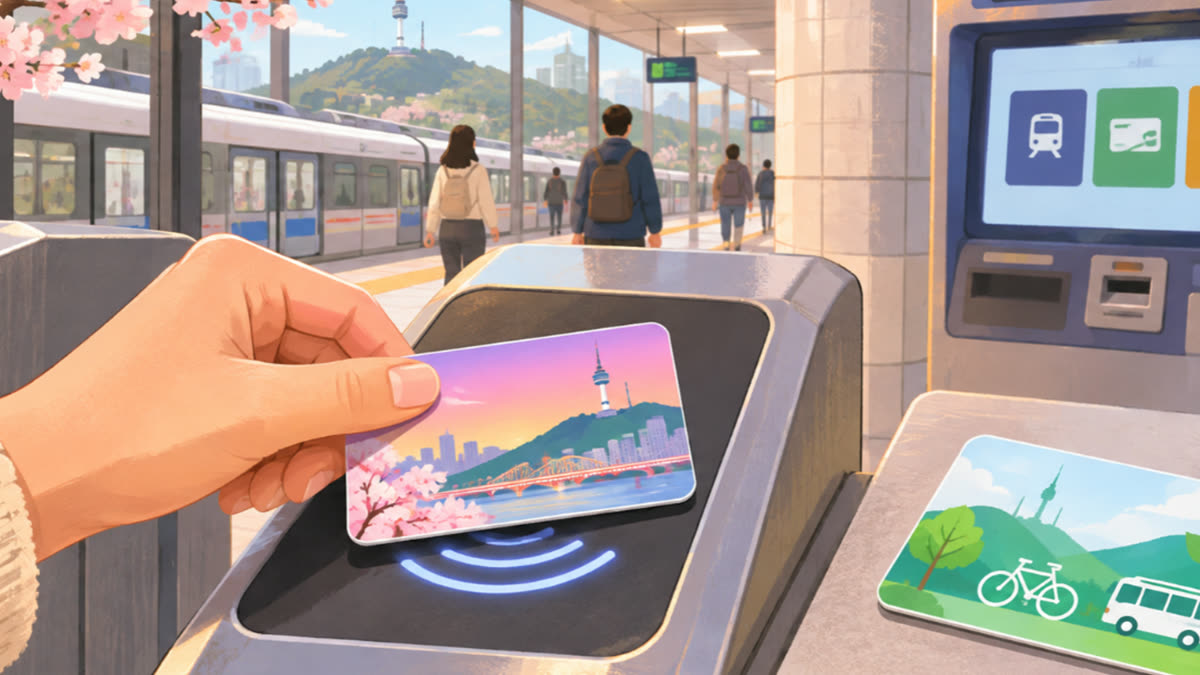
For most trips, the simplest choice is a basic T-money card. It costs 3,000 won at a convenience store, and you load cash onto it. One card covers Seoul's subway and buses, and you pay less per ride than with cash. If you'll ride a lot over a few days and stay inside Seoul, think about a Climate Card short-term pass as well. It gives unlimited rides for 1 to 7 days, and the 7-day pass costs 20,000 won.
This guide covers how T-money works in Seoul: where to buy a card, how to top it up, what fares cost, how transfers work and how to get leftover money back. It also covers the Climate Card short-term pass, including what it covers and what it doesn't. Prices and rules were checked on November 3, 2026.
What is a T-money card, and do you need one?
T-money is Korea's main prepaid transit card. You load money onto it and tap it on the reader at subway gates and on buses, and the fare comes off your balance. You can buy it and top it up at convenience stores and subway stations.
You can ride without one, but cash costs more. A basic adult subway ride in Seoul is 1,550 won by card and 1,650 won in cash. The subway-bus transfer discount is also only for card users. A basic adult card works as soon as you load it, with no sign-up. You only need to register it in a few cases, such as getting a teen or child fare.
Where to buy a T-money card in Seoul
T-money's own price list, checked on November 3, 2026:
| Card | Price | Where |
|---|---|---|
| Basic T-money card (Basic Gray) | 3,000 won (about $2) | 7-Eleven, Emart24, street kiosks |
| GS25 and CU basic cards | 3,000 won | GS25 and CU stores |
| Tmoney Travel Card (for foreign visitors) | 4,000 won | Convenience stores, staffed bus ticket counter at Incheon Airport |
| Tmoney Travel Card + (adds WOWPASS payment) | 6,000 won | Convenience stores |
| Line Friends hanbok design card | 5,000 won | Airport Railroad (AREX) |
USD figures are rough. You pay for the card once, and that money doesn't come back, so a basic card is enough for most visitors. New cards hold no money, so top up before your first ride.
If you arrive at Incheon Airport, you can get a card before heading into the city. For your choices from the airport, see our guide to Incheon Airport to Seoul: AREX vs Airport Bus vs Taxi, Day and Night.
How do you top up a T-money card?
There are two main places to top up:
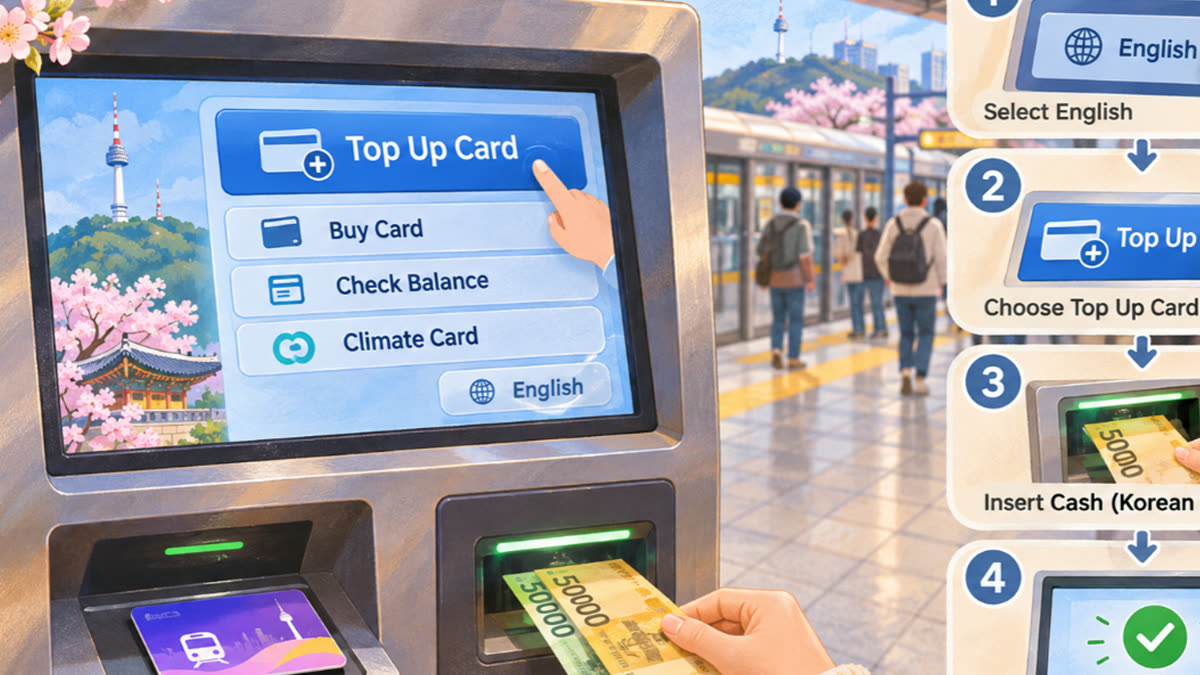
- Convenience stores (GS25, CU, 7-Eleven, Emart24, MINISTOP, Story Way, 365PLUS): give the cashier your card and the cash, and say how much you want to add.
- Subway stations: use the top-up or ticket machines near the gates, or ask at the information center.
Using a station machine:
- Switch the screen to English.
- Put your card on the card tray and choose top-up.
- Pick an amount and put in your cash.
- When the screen says the top-up is done, take your card.
You add money in 1,000-won steps, from 1,000 up to 90,000 won each time. A card can hold up to 500,000 won. Bring Korean won in cash. It's the simplest way to top up at both store counters and station machines.
How much do the subway and bus cost with a T-money card?
Seoul adult fares as of November 3, 2026:
| Ride | Card | Cash |
|---|---|---|
| Subway, base fare (rises with distance) | 1,550 won | 1,650 won |
| Blue and green city buses | 1,500 won | 1,500 won |
| Circular buses | 1,400 won | 1,400 won |
| Village (maeul) buses | 1,200 won | 1,200 won |
| Late-night buses | 2,500 won | 2,500 won |
| Red wide-area buses | 3,000 won | 3,000 won |
Long subway trips cost more than the base fare. From the first train or bus until 6:30 a.m., the card fare is 20% lower. Teen cards (ages 13 to 18) and child cards (ages 6 to 12) pay less, but you have to register them with a date of birth. An adult caught using a teen or child card is fined 30 times the base fare.
How do T-money transfer discounts work?
If you switch from subway to bus, bus to subway, or one bus to another within 30 minutes, the fare is combined into one trip. Between 9 p.m. and 7 a.m., you have up to one hour. You can get the discount for up to four transfers. The next ride isn't free. You usually pay only the extra charge for distance or for a pricier bus, not a new full fare. Getting back on a bus on the same route doesn't count as a transfer.
What is the Climate Card short-term pass?
The Climate Card (기후동행카드) is Seoul's unlimited-ride transit card. Visitors can buy it as a short-term pass:
| Pass | Price |
|---|---|
| 1 day | 5,000 won |
| 2 days | 8,000 won |
| 3 days | 10,000 won |
| 5 days | 15,000 won |
| 7 days | 20,000 won (about $14) |
On top of the pass, the physical card costs 3,000 won, and that isn't refunded. Seoul's current FAQ lists the 7-day price. The 1- to 5-day prices come from the city's own tourist-pass article, so check the price on screen before you pay. Short-term passes don't come with discounts such as the young-adult or low-income discounts. The one exception is for teens born from 2008 to 2013 who verify their age on the T-money website: they can buy a 7-day pass for 13,000 won through December 31, 2026.
Where to buy and charge the Climate Card
- The card: sold at stores inside subway stations and at convenience stores. Use the convenience store chain's app to see which branches have it.
- Charging: at the self-service charging machines in stations, or in the Mobile T-money app. Since March 17, 2026, the new-style machines on Seoul Metro Lines 1 to 8 take foreign-issued credit and debit cards for short-term passes.
- Start date: the pass starts on the day you charge it. You can't charge it early for a later date, so wait until the day you start riding.
What does the Climate Card cover, and what does it leave out?
Covered:
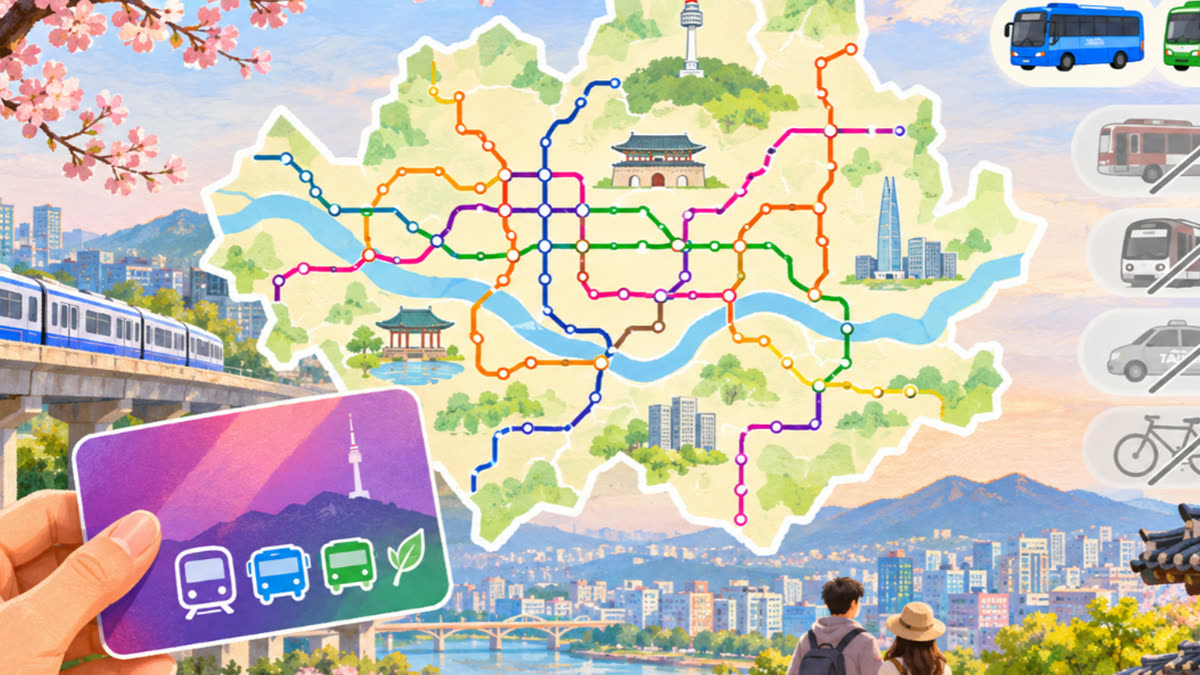
- Subway trips inside Seoul. You can also get off at Incheon Airport Terminal 1 or 2, but you can't start a trip there.
- Seoul-licensed city buses and village buses, including late-night and circular buses.
Not covered:
- The Shinbundang Line.
- Buses from Gyeonggi Province and other areas outside Seoul. On those, the driver charges a separate fare. Red wide-area buses aren't on the covered list either.
- Taxis, Ddareungi bikes and the Han River Bus.
If you board inside Seoul and get off outside the covered area, for example in Incheon, station staff will charge you a separate fare. The city's example is 1,950 won from Seoul Station to Bupyeong Market. After a pass ends, it still works on late-night buses until 4 a.m. the next morning.
T-money or Climate Card: which should you get?
The 1-day pass pays off at about four base-fare rides. Three subway rides on T-money come to 4,650 won, still a bit under 5,000 won. The longer passes cost less per day: about 3,300 won a day on the 3-day pass and under 3,000 won a day on the 5- and 7-day passes. So with those, about two rides a day is enough to come out ahead.
- Choose T-money if you ride only a few times a day, take day trips outside Seoul, or plan to use the Shinbundang Line or red buses.
- Choose the Climate Card if you're staying in Seoul for several days and moving between neighborhoods from morning to night.
Many visitors carry both. They use the Climate Card for rides it covers and a T-money card for everything else.
What happened to the 30-day Climate Card?
The 30-day unlimited Climate Card has ended. The last day to charge it was August 31, 2026, and it ended for good on October 1, 2026. Seoul now points regular riders to the national Moduui Card (모두의 카드, K-Pass). The city says it gives the same discounts as before, except the youth and veteran discounts. Seoul also launched a Climate Pass with extra benefits for Seoul residents on September 1, 2026, and you get it by joining the Moduui Card first. These options are meant for people who live in Korea. Short-term passes (1, 2, 3, 5 and 7 days) are still on sale.
How do you get a refund on a T-money card?
You can get your remaining balance back in cash, minus a 500-won fee. The price you paid for the card itself isn't refunded.
- Where: places that sell or top up T-money cards can refund the balance. Show the card and say how much you want back.
- Partial refunds: only Tmoney Town (Seoul Station Exit 10, Seoul City Tower 1F) and the T-money service centers in subway stations can refund part of a balance.
Climate Card pass refunds work differently. You must register the card on the T-money website and request the refund there. The money goes only to a Korean bank account in your own name, and you can't get a refund once the pass has expired. In practice, most short-term visitors can't get money back for unused days.
Good to know
- One card per person. A Climate Card pass can't be shared or passed on. If it's misused, you pay the fare plus 30 times that fare.
- Carry some cash in won for top-ups at stores and station machines.
- Check your balance on the reader screen when you tap, or at a station machine.
- Tap one card at a time. If you hold a wallet with two transit cards against the reader, it may charge the wrong card or show an error.
- Getting help: for help in other languages, call Seoul's Dasan Call Center at 120 and press 9. T-money customer service is 1644-0088, on weekdays from 9 a.m. to 6 p.m.
- Leaving Seoul? The Climate Card short-term pass works only in Seoul's covered area. Use T-money for trips beyond it.
FAQ
Can tourists use a T-money card in Seoul without a Korean phone number?
Yes. You can buy a basic card at a convenience store, top it up with cash and start riding right away. You don't need to register an adult card. You'll need to register only for a teen or child fare, or to get a refund on a Climate Card pass.
Can I top up a T-money card with a credit card?
Plan on paying cash for ordinary T-money top-ups. The Climate Card short-term pass is different. Since March 17, 2026, the new machines on Seoul Metro Lines 1 to 8 take foreign-issued credit and debit cards for it.
Does the Climate Card work to Incheon Airport?
Yes, but only one way. You can board in Seoul and get off at Incheon Airport Terminal 1 or 2. You can't start a trip at the airport with it, so use T-money for the ride into the city.
Is the Climate Card worth it for a 3-day trip?
The 3-day pass costs 10,000 won, which is about seven base-fare subway rides. If you're sightseeing around Seoul every day, it usually pays off. If you're planning day trips outside Seoul, such as to Suwon or Incheon, T-money may cost less.
Can I get my T-money balance back when I leave Korea?
Yes. Places that sell or top up T-money cards can refund your balance. Tmoney Town at Seoul Station and the service centers in stations can also refund part of it. Each refund costs 500 won, and the card price isn't refunded.
Sources
- T-money – Guide for foreigners (top-up, refund, transfer)
- T-money – Seoul public transport fares
- T-money – Card types and prices
- T-money – Foreigner-only cards (Tmoney Travel Card)
- Seoul Metropolitan Government – Climate Card short-term pass FAQ
- Seoul Metropolitan Government – Climate Card 30-day pass end FAQ
- Seoul Mediahub – Climate Card tourist short-term passes
Facts were checked against the sources above; the article itself was written by Seoul Sidekick. Report an error