Korean BBQ Etiquette: How to Order, Grill, Wrap and Pour Like a Local
Korean BBQ etiquette made simple: how to order by the serving, who grills, how to build a ssam wrap, pouring soju with two hands, what a meal costs in Seoul and the mistakes to avoid.
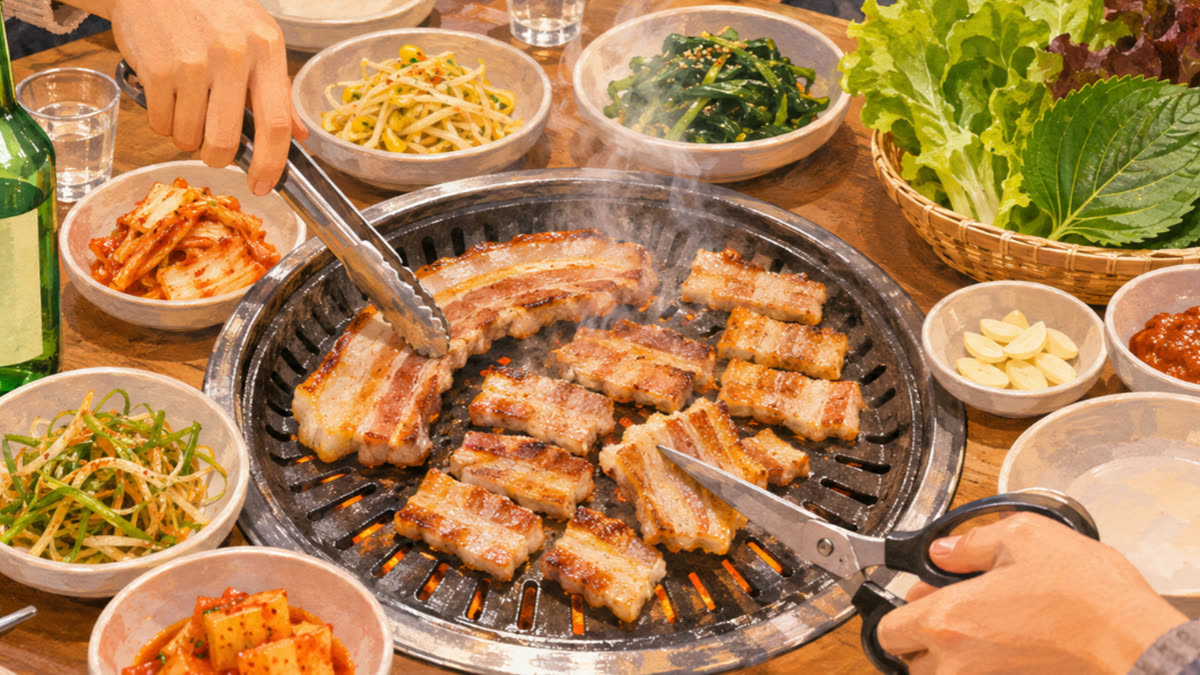
Korean BBQ etiquette comes down to a few habits. You order meat by the serving. Someone at the table, often the youngest, does the grilling unless the staff take over. You eat each lettuce wrap in one bite. And you don't pour your own drink. Get those four right and you will fit in at almost any grill restaurant in Korea, from a smoky neighborhood pork joint to a smart beef house in Gangnam.
This guide goes through a Korean BBQ meal in the order it happens: walking in, ordering, grilling, wrapping, drinking and paying. It also covers what a meal costs and the mistakes first-timers make most often.
How does Korean BBQ etiquette work, step by step?
The table has a clear rhythm and everyone has a part to play. Here it is from start to finish:
- Sit down. If you are with Korean hosts or older people, wait to be shown your seat. The seat of honor is usually the one farthest from the door, and it goes to the oldest or most senior person. Don't take it unless you are invited to.
- Order meat by the serving (inbun, 인분). One serving per person is a sensible start. You can always add more.
- Side dishes arrive. Lettuce, sesame leaves, kimchi, garlic, ssamjang and other banchan come with the meat. Refills are usually free.
- Grill. At some places the staff cut and turn the meat. At others the table does it.
- Wrap and eat. Wait until the oldest person starts eating. Then make a ssam wrap with your fingers and eat it in one bite.
- Pour and toast. Pour for others, use two hands with elders, and say geonbae (건배, cheers).
- Finish with a carb. Many people end with fried rice made on the grill, cold noodles (naengmyeon) or a doenjang stew with rice.
- Pay at the counter. At many restaurants you pay by the door on the way out. There's no tipping.
How do you order at a Korean BBQ restaurant?
Most menus list meat per serving, often with the weight in grams. Weights vary a lot from one restaurant to the next. A serving of pork belly can be anywhere from about 100 g to 250 g, which is why the Korea Consumer Agency converts every restaurant's price to a standard 200 g when it compares them. When you read a menu, look at the gram figure as well as the price.
Common cuts to know:
- Samgyeopsal (삼겹살): pork belly, the classic and usually the cheapest
- Moksal (목살): pork neck or shoulder, leaner and chewier
- Galbi (갈비): ribs, often marinated (yangnyeom galbi)
- Hangjeongsal (항정살): pork jowl, fatty and crisp
- Chadolbagi (차돌박이): thin-sliced beef brisket that cooks in seconds
- Hanu (한우): Korean native beef, much more expensive than imported beef
Useful phrases:
- Samgyeopsal sam-inbun juseyo (삼겹살 3인분 주세요): pork belly for three, please
- Yeogiyo! or Jeogiyo! (여기요 / 저기요): excuse me, to call staff. Some tables also have a call button.
- Banchan deo juseyo (반찬 더 주세요): more side dishes, please
- Gyesan haejuseyo (계산해 주세요): the bill, please
To find a restaurant, search 삼겹살 or 고기집 in a Korean map app. These apps usually have more local reviews and photos than Google does. See our Best Map App for Korea: Naver Map, Kakao Map, Kakao T and Papago guide.
How much does Korean BBQ cost in Seoul?
Prices change by neighborhood, restaurant and cut, so treat these as a guide. The Korea Consumer Agency's Price Portal (참가격) put the cost of eating pork belly at a Seoul restaurant at 21,321 won per 200 g in June 2026. That was 4.3% higher than in June 2025, when it was 20,447 won. The figure is not an average of menu prices. It converts what restaurants charge to a 200 g basis, so a menu price for a smaller serving can look lower.
Eating out costs far more than cooking at home. In August 2026, domestic pork belly bought raw at retail averaged about 2,596 won per 100 g, according to the Korea Institute for Animal Products Quality Evaluation.
| Item | Typical price |
|---|---|
| Pork belly at a Seoul restaurant, per 200 g (June 2026 average) | about 21,300 won |
| Soju, one bottle at a restaurant | about 4,000 to 6,000 won, sometimes more |
| Domestic pork belly bought raw at retail, per 100 g (August 2026) | about 2,600 won |
| Side dish refills | usually free |
Each restaurant sets its own soju price, and the bill depends a lot on where you eat. As a rough guide, two people sharing four 200 g servings of pork belly at the Seoul average comes to about 85,000 won. Add three bottles of soju at 6,000 won each and the total is just over 100,000 won, before any rice or stew. Beef, and Korean hanu in particular, costs a lot more than pork.
Who grills the meat at Korean BBQ?
In a group of friends or colleagues, the youngest or most junior person often takes the tongs and scissors. When you are a guest, it is polite to offer, even if your hosts say no. At many popular places, especially ones serving thick-cut pork or expensive beef, the staff grill and cut the meat for you. If they come over with tongs, let them work.
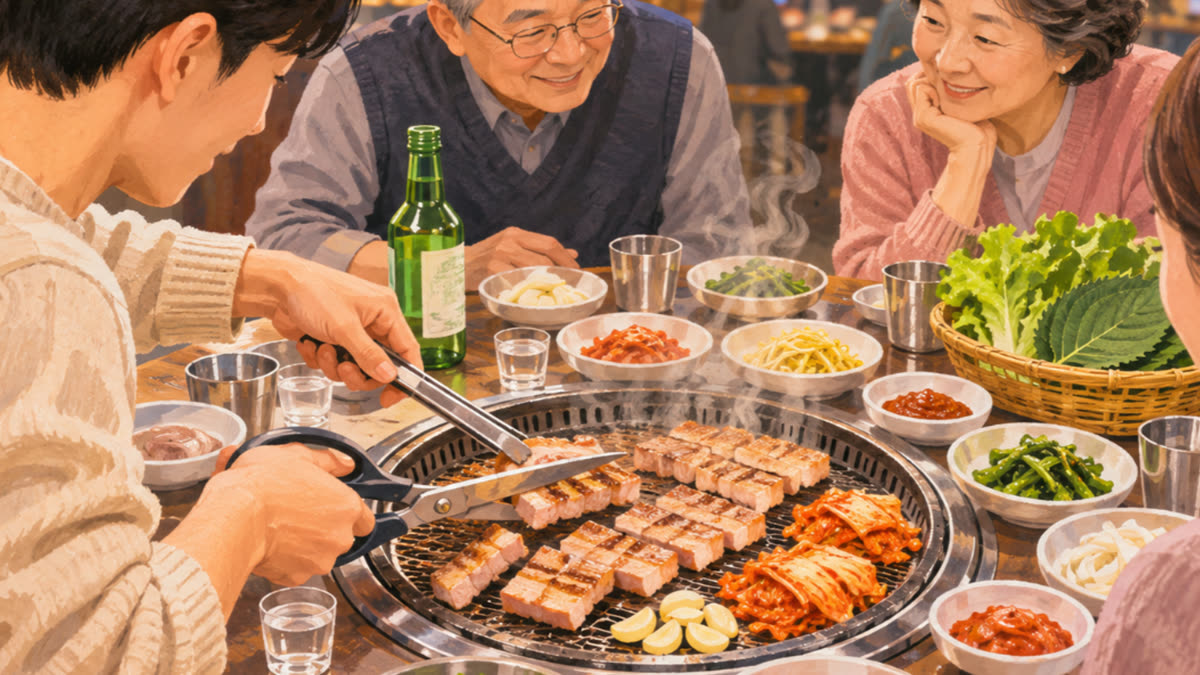
Grilling tips:
- Let the meat brown before flipping. Turning it all the time is the classic beginner mistake.
- Cut with scissors. Kitchen scissors are the normal tool for cutting meat into bite-size pieces on the grill.
- Plain meat first, marinated meat later. Marinade burns and sticks, so cook the unmarinated cuts first or ask for a new grill plate.
- Garlic and kimchi go on the grill too. Put them at the edge of the plate so they cook in the pork fat.
- Ask for a grill change (bulpan gara juseyo, 불판 갈아 주세요) when the plate turns black.
- Share the cooked meat onto other people's plates, starting with the elders, before you take your own.
How do you make a ssam (lettuce wrap)?
Ssam is the one part of a Korean meal where eating with your hands is normal. Here is how to build one:

- Hold a lettuce leaf or sesame leaf flat in your palm.
- Use chopsticks to add a piece of meat. Dip it in salt, sesame oil or ssamjang first if you like.
- Add extras: a slice of grilled garlic, kimchi, green onion salad (pajeori) or a little rice.
- Fold it into a small parcel and eat it in one bite.
If the wrap is too big for one bite, make the next one smaller. A ssam bitten in half tends to fall apart. Remember that the side dishes are shared, so don't take all the garlic or move a whole dish to your side of the table.
What are the drinking rules at Korean BBQ?
Pork belly and soju go together. Most Korean drinking etiquette is about showing respect for age and seniority. It matters most with older people and at work dinners. Among friends of the same age, the rules relax a lot.
- Don't pour your own drink. Fill other people's glasses and let them fill yours. With a senior, it is safest to offer ("Would you like more?") before you pour.
- Use two hands with elders. To pour for someone older, hold the bottle in your right hand and rest your left hand on your right forearm or under the bottle. To receive a drink, hold the glass with both hands.
- Clink a little lower. When you toast with someone senior, touch your glass slightly below theirs.
- Turn your head. When you drink in front of an elder, turn slightly away from them as you sip.
- Don't top up a glass that isn't empty. Adding alcohol to a glass that still has some in it (cheomjan, 첨잔) is generally avoided, except in ancestral rites. Wait until the glass is empty, and don't fill it right to the brim.
- Say early if you don't drink. Saying politely at the start that you don't drink is easier than turning down glasses all night. Health or driving home are accepted reasons. If you want to join in without drinking much, raising the glass to your lips for the first toast is enough.
Pressure to drink has eased a lot. Heavy drinking with colleagues was common in the 1990s and 2000s, but in Korean workplaces today, forcing someone to drink is seen as a form of workplace abuse.
What are the most common Korean BBQ mistakes?
- Starting to eat before the oldest person at the table picks up their chopsticks
- Sticking chopsticks upright in a bowl of rice, which looks like the incense at a funeral
- Lifting the rice or soup bowl to your mouth (it stays on the table, and you use a spoon)
- Pouring your own soju
- Flipping meat every few seconds, or cooking marinated meat first on a clean grill
- Taking the last piece without offering it to others
- Leaving a tip (it isn't expected and may be handed back)
Good to know
- Clothes smell of smoke. Some BBQ places give you a bin or plastic cover for your coat. Use it, or leave your best jacket at home.
- Paying: At a Korean-hosted meal, the senior person or whoever invited you traditionally pays, though splitting the bill is becoming more common. Offering to pay for coffee or the second round (icha, 2차) is a good way to return the favor. Among friends, splitting is normal.
- Say thanks: Say jal meokgetseumnida (잘 먹겠습니다, "I will eat well") before eating and jal meogeotseumnida (잘 먹었습니다, "I ate well") afterwards, especially to whoever is paying.
- Solo diners: Some grill restaurants won't serve meat for one person. Look for places that advertise 1인 (single-person) service.
- Where to go: Mapo, Hongdae, Sinchon, Euljiro and Gangnam all have plenty of BBQ restaurants. Our guide to where to stay in Seoul covers these neighborhoods.
FAQ
Do you tip at Korean BBQ restaurants?
No. Tipping isn't customary in Korea, and staff may refuse it or bring back change you leave behind. The price on the menu is what you pay, and at many restaurants you pay at the counter by the door on your way out.
Is it rude to grill your own meat at Korean BBQ?
No. Grilling at the table is normal and expected at most places. If a staff member comes over to grill or cut the meat, let them. Some restaurants like to control the cooking themselves, especially for thick pork or premium beef.
How much meat should I order at Korean BBQ?
One serving per person is a good start. Order more as you go. Check the gram weight on the menu, because a serving can be anywhere from about 100 g to 250 g depending on the restaurant.
Can I pour my own drink in Korea?
Close friends won't mind much, but the tradition is to pour for others and let them pour for you. If your glass is empty, filling a friend's glass usually gets yours refilled too.
Are side dishes free at Korean BBQ?
Usually, yes. Banchan such as kimchi, lettuce, garlic and ssamjang normally come with the meat and are refilled for free. Just ask. Some restaurants charge extra for items like steamed egg or stew, so check the menu.
Sources
- Segye Ilbo: Seoul samgyeopsal dining price, June 2026 (Korea Consumer Agency Price Portal data)
- News-wa: Why a serving of samgyeopsal tops 20,000 won (Aug 2026)
- Korea Herald: How about a drink? What alcohol means to business in Korea
- Seoul Tourism: Korean Dining Etiquette
Facts were checked against the sources above; the article itself was written by Seoul Sidekick. Report an error